The organization
A construction company in Rhode Island whose office manager was retiring after decades in the role.
What was happening
Everything about how the office ran lived with one person. Vendors, permits, billing sequences, which inspector wanted what, how a job moved from signed to invoiced. She was retiring. Nothing was written down, nobody had time to write it down, and the owner could not see what she did all day or what would stop when she left.
What we looked at
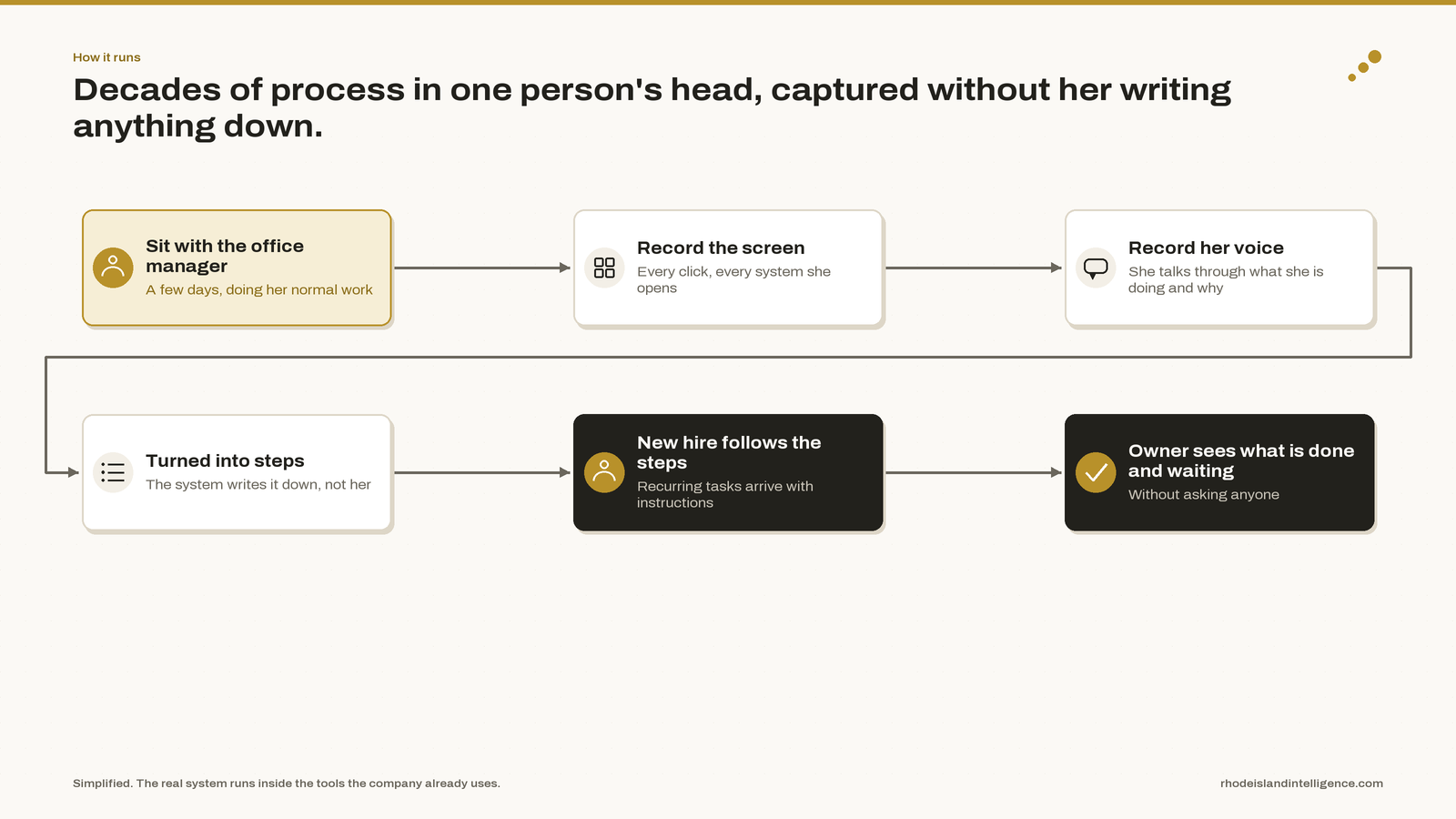
We sat with her for a few days while she did her normal work, recording her screen and her voice as she talked through what she was doing and why. She did not have to write anything down or prepare anything. The point was to capture the work as it actually happened, including the exceptions she handled without thinking about them.
What we built
The recordings became her procedures: step-by-step instructions a new hire can follow, recurring tasks that appear on schedule with the instructions attached, and a view for the owner of what is done and what is waiting. The knowledge now belongs to the company rather than to a person.
What changed
A new hire took over without the business missing a step. The owner can see the office for the first time. The same approach is the foundation for a private model that can answer questions from the company's own history.
More delivered work
- Millwork manufacturer Material takeoffs that took up to a week per job now take minutes, with the same estimator.
- Millwork manufacturer Every invitation read as it arrives, added to the bid schedule and ranked against the plant's own criteria.
- Construction company Jobs, money and open issues on one screen, with urgent items pushed to the owner the moment they happen.